DIY Flag Burning Steps
Each year, between Flag Day (June) and Independence Day (July), many hold ceremonies to properly dispose of the American Flag. These ceremonies often result in the burning of an American Flag that has become worn through use and is no longer serviceable. It is important to note that flag burning of any kind is permitted under the law. A U.S. Supreme Court decision upholds that right, as we will examine here.
Is Flag Burning Legal?
In 2025, some controversy was generated when the President of the United States suggested flag burning should be illegal. The old saying, “Ignorance of the law is no excuse,” definitely applies here.
In the 1980s, an American citizen named Gregory Lee Johnson burned an American flag outside the 1984 Republican National Convention in Dallas, Texas. According to USCourts.gov, “Johnson burned the flag to protest the policies of President Ronald Reagan. He was arrested and charged with violating a Texas statute that prevented the desecration of a venerated object, including the American flag, if such action were likely to incite anger in others.”
A Texas court convicted Johnson, who appealed to the Supreme Court.
USCourts.gov notes, “The majority of the Court, according to Justice William Brennan, agreed with Johnson and held that flag burning constitutes a form of ‘symbolic speech’ that is protected by the First Amendment. The majority noted that freedom of speech protects actions that society may find very offensive, but society’s outrage alone is not justification for suppressing free speech.”
According to the Supreme Court decision, any type of flag burning is permitted as free speech.
How to Burn The U.S. Flag
Burning an American flag is addressed in the United States Flag Code, and there are specific procedures required to dispose of a worn, damaged, or no-longer-serviceable American flag.
Flag burning is serious business, and there is an important safety component associated with any ceremony designed to properly burn a flag. The largest source of house fires in America involves unattended heat sources, including open flame. Do not leave a source of flame or ignition unattended, do not burn a flag without a fire extinguisher, and do not let children handle flame or ignition sources.
Proper U.S. Flag Disposal
To conduct a private disposal ceremony, the Veterans of Foreign Wars advises the following steps:
- Fold the flag
- Ensure fire is large enough to consume the flag
- Place flag in fire
- Salute
- Recite the Pledge of Allegiance, hold a moment of silence
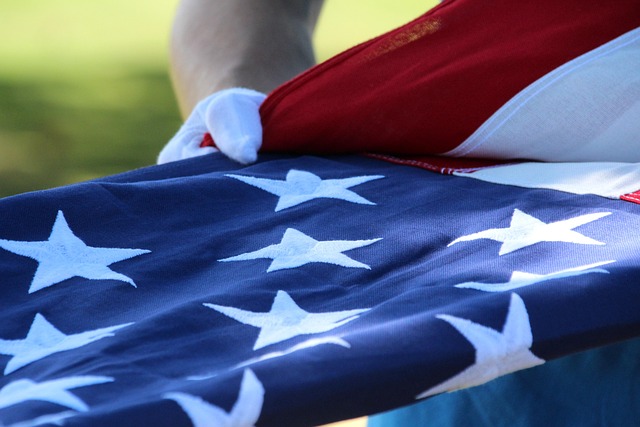
As mentioned above, the American flag must be folded in the proper manner before disposal. Why? It helps to ensure the colors are properly formed to be consumed by fire all at once.
As for the place where you intend to burn the flag, the area must be large enough to accommodate the wholeness of the folded flag, so as not to leave any part of it unconsumed.
Carefully place the folded flag into or onto the fire you’ve prepared. In some cases, you may be placing the flag into a large flame, so please be careful not to burn yourself.
Once you’ve placed the folded colors in the ceremonial flames, render a salute, either military or civilian, and recite the Pledge of Allegiance. Alternatively, holding a moment of silence as the flag is consumed is also appropriate and respectful.
Once the fire wholly consumes the flag, safely extinguish the flames. When possible, collect and bury the ashes. Of course, the VFW insists that you follow all local and state ordinances when it comes to open flames.
The American Legion Ceremony
The American Legion has a special Ceremony for Disposal of Unserviceable Flags, which was adopted in September of 1937. The reason the Legion adopted such a ceremony was to encourage respect for our Nation’s colors and to ensure that worn flags were disposed of in a dignified manner.
In this ceremony, the entire Post assembles outdoors, usually at night, and forms two parallel rows of people facing each other about 20 feet apart.
As the flags are brought up, the Sergeant-at-Arms facilitates an inspection of the flags by senior Legion members. Once they are all inspected, the Legion Commander forms the Color Guard. All members who are not part of the Color Guard salute as the flags are dipped in kerosene and placed in the fire. At the same time, a bugler plays “To the Colors”.
An Alternative to Flag Burning
While a ceremonial burning of the flag is considered the most appropriate method of disposal, another option that is less often used is burying the flag. Since the ashes of burned flags are often buried, this method foregoes the flame and moves directly into burial.
According to guidance from the National Flag Foundation, an American flag must be:
- Folded properly
- Placed in a respectable box or container
- Buried, with a moment of silence
This is appropriate when the worn flag is composed of synthetic material, like nylon, that can emit hazardous fumes when burned. Alternatively, if someone does not live near an organization that collects worn flags, this method is also suitable.
Where to Take Worn US Flags
Throughout the year, various organizations collect worn flags via drop boxes at their locations. They include:
- The American Legion
- Veterans of Foreign Wars
- The Boy Scouts
- The Girl Scouts
RELATED:
- 4th of July Sales and Discounts for Military, Veterans
- How to Celebrate Father’s Day, by Service Branch
- Four Chaplains Day, February 4th
- The History of the 4th of July
- Veteran Asbestos Exposure and VA Policy
- VA Home Loan Policy Updates
About the author
Julie Provost is a freelance writer, and blogger. She lives in Tennessee with her National Guard husband and three boys.