House Armed Services Committee Votes Against Executive Order on Base Names
The House Armed Services Committee voted to change the names of nine major southern military installations and rename the Department of Defense to the “Department of War”. These changes are not yet law; they were introduced as legislative amendments during a late-night committee session in early June 2026.
House Armed Services Committee Votes Against Executive Order on Base Names
The amendment, sponsored by Representative Marilyn Strickland, would reinstate U.S. military base names chosen by a federal commission in 2023. The changes were intended to remove the names of Confederate soldiers from military facilities.
ArmyTimes notes Strickland’s complaint alleging, ” …the Trump administration ignored Congress by changing the new names, choosing to honor, instead, different service members with the same last names as the Confederate officers for which the bases originally were named.”
>> Never miss benefits news and updates that are important to you. Sign up today to receive the MyMilitaryBenefits newsletter free to your inbox.
Reinstating the Naming Commission Selections
Congress established a bipartisan military base Naming Commission in 2020 to remove the names of Confederate soldiers from military installations. This passed both chambers and survived a presidential veto. The commission completed its work in 2023, selecting new names to replace names tied to the Confederacy.
Opponents of the amendment argued that the historic names carry historic meaning for the troops who served there, regardless of the original namesake’s history. But others question the logic of naming a U.S. military base after people who led an armed insurrection against the United States of America.
If the Strickland amendment successfully passes into law, the installations will revert to the specific names selected by the Naming Commission.
- Fort A.P. Hill would become Fort Walker.
- Fort Bragg would become Fort Liberty.
- Fort Benning would become Fort Moore.
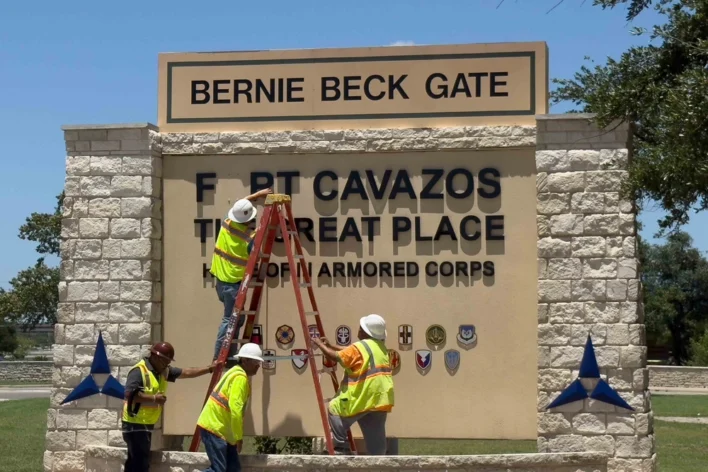
- Fort Hood would become Fort Cavazos.
- Fort Lee would become Fort Gregg-Adams.
- Fort Polk would become Fort Johnson.
- Fort Rucker would become Fort Novosel.
- Fort Pickett would become Fort Barfoot.
- Fort Gordon would become Fort Shughart-Gordon.
Transitioning to the Department of War?
The committee also approved an amendment to permanently rename the Department of Defense. The executive branch previously issued an executive order in September 2025 establishing the “Department of War,” but permanent changes to the name “Department of Defense” require authorization from Congress.
Critics on the committee raised practical objections to the proposal. Representative Adam Smith argued that changing the name would not influence international adversaries or alter the military’s daily operations. He noted that a permanent name change would impose avoidable costs to rebrand the Defense Department, including new logos, signage, and changes to DoD websites.
What’s Next
The proposed changes discussed here are not currently law; they exist only as part of a committee-approved draft of the annual defense spending bill (at press time).
Before any of these changes become law, the full House of Representatives must vote on the bill as a whole. The Senate must then debate, amend, and pass its own version of the defense bill. Lawmakers from both chambers will eventually need to reconcile the differences between their versions of the bill. The finalized compromise bill must then be sent to the president for a signature or a veto override.
The House Armed Services Committee’s vote merely incorporates these provisions into the preliminary draft of the National Defense Authorization Act for the upcoming fiscal year.
Will the Senate debate these issues?
The legislative process for defense authorization requires parallel actions from both chambers of Congress. The Senate Armed Services Committee must draft its own independent version of the defense bill.
Once both committees finish their drafts, the full House and the full Senate will debate their respective versions on the chamber floors. Individual senators will have the opportunity to propose amendments to retain, alter, or strike down provisions regarding base names and the Department of War.
Because the two chambers rarely produce identical bills, leadership will appoint a conference committee composed of both representatives and senators. This panel will negotiate a final compromise text. If the Senate objects to the Department of War title or the base-renaming provisions, those items could be removed during conference negotiations. Only after both houses pass the identical compromise text will the bill move to the president for signature into law or veto.
>> Never miss benefits news and updates that are important to you. Sign up today to receive the MyMilitaryBenefits newsletter free to your inbox.
About the author
Editor-in-Chief Joe Wallace is a 13-year veteran of the United States Air Force and a former reporter/editor for Air Force Television News and the Pentagon Channel. His freelance work includes contract work for Motorola, VALoans.com, and Credit Karma. He is co-founder of Dim Art House in Springfield, Illinois, and spends his non-writing time as an abstract painter, independent publisher, and occasional filmmaker.